
I entered the Google Cloud Rapid Agent Hackathon almost by accident. I saw it in my feed two days before the deadline and decided to use it as a quick product-thinking experiment.
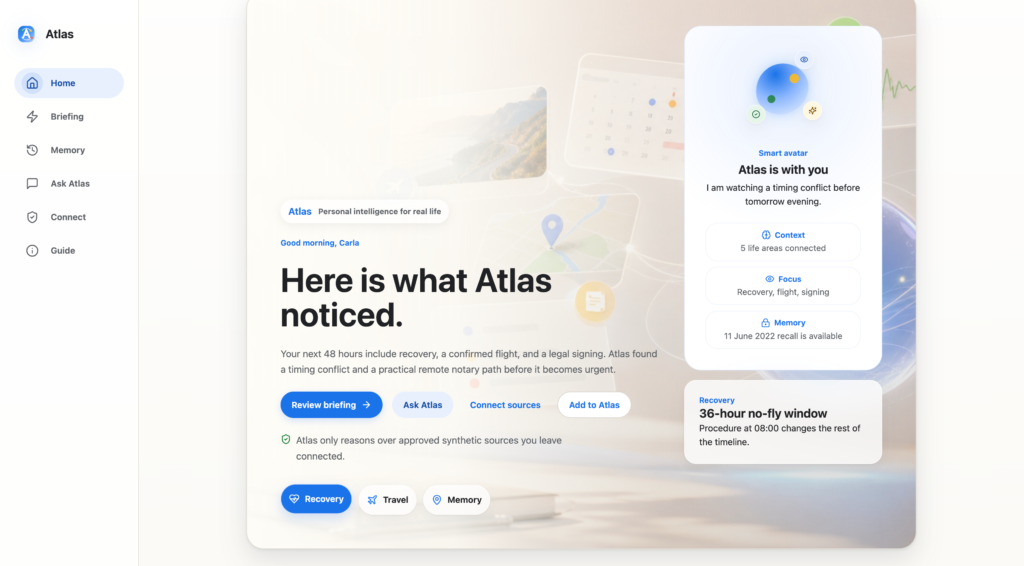
The first working prototype was built in about 3 hours : Atlas: Ambient Life Intelligence.
The problem Atlas is exploring
Atlas is based on a simple problem. Most of our important information already exists somewhere, but it is scattered. A medical instruction might be in a PDF. A flight might be in an email. A deadline might be in a calendar. A legal clause might be in a document. A family commitment might be in a message. A memory might be something we vaguely know, but cannot quickly find when we need it.
Each piece may look small on its own. The real risk often appears only when those pieces are put together.
That is the bit I find interesting. Not AI as a clever search box. Not AI as a prettier dashboard. AI as a reasoning layer that can look across approved sources and say: something does not add up here.
The demo scenario
The main demo scenario is called the Post-Op Compliance Trap. The person has a medical procedure at 08:00, a 36-hour no-fly instruction, a flight at 19:30, a legal signing the next morning, a deadline at noon, and a $250,000 valuation risk if the signing is missed.
Individually, these are just normal pieces of admin. A calendar can show the flight. A document can contain the medical instruction. A contract can contain the legal workaround. But the real problem sits between the tools.
That is where Atlas comes in. It connects the approved signals and explains the situation as a story: the person should not fly tonight because the flight falls inside the post-op restriction window, but the legal signing still matters, so the safer route may be a remote notary option, with the user’s approval.
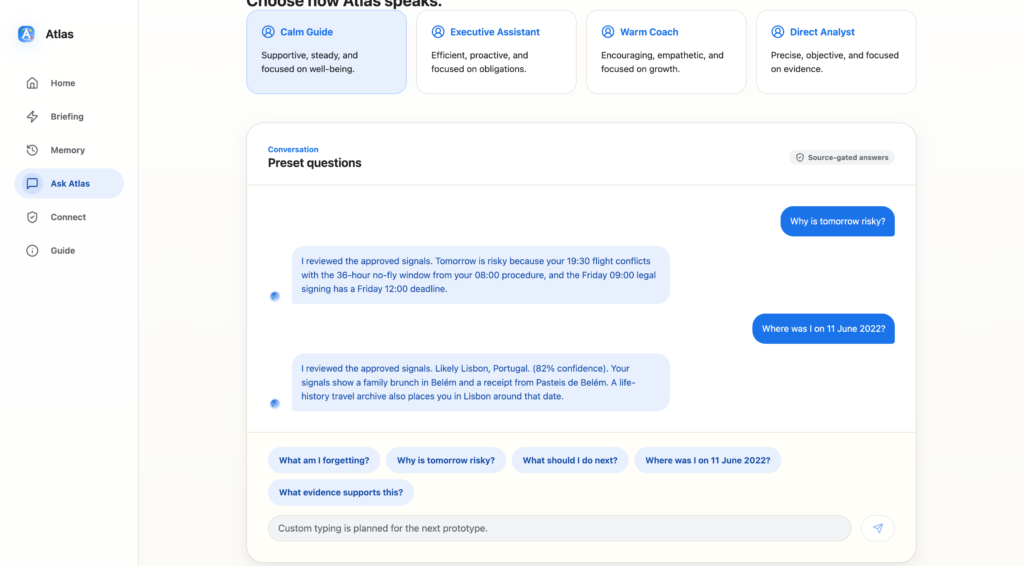
That is the kind of AI product I would actually use. I do not want more notifications. I want help understanding what the notifications mean together.
Life-story format
The life-story format matters because people do not think in database rows. Life admin is messy. It is spread across documents, calendars, emails, messages, memory, and half-finished thoughts. A good assistant should reduce the amount of context a person has to carry in their head.
Atlas is my attempt to explore what a personal intelligence layer could look like if it was built around consent, evidence, and user control from the beginning. The rules matter. Atlas should only use sources the user has approved. If something is disconnected, it should not reason over it. If evidence is missing, it should say so. If it suggests a next step, the user should still approve it.
It should detect, explain, prepare, and ask. It should not silently act.
Where the pattern could go?
I also think this pattern could become much bigger than one life-admin demo. A legal version could connect clauses, signing deadlines, evidence, and risk. A health version could connect appointments, recovery instructions, medication notes, and follow-ups. A family-care version could connect school messages, documents, appointments, and shared responsibilities. A finance version could connect bills, contracts, deadlines, and consequences.
The structure stays the same: connect approved sources, find the conflict or opportunity, explain the story, show the evidence, suggest the next step, and keep the person in control.
That is what I wanted to test with Atlas. Not whether I could make a pretty prototype. Not whether I could add AI branding to a page. I wanted to see whether I could take an abstract agent idea and turn it into something that feels like a real product direction.
Technical path
Technically, the prototype uses React, Vite, Sass, Lucide React, Vercel, synthetic local data, MongoDB-shaped seed collections, Google ADK, Gemini / Vertex AI proof scripts, Google Cloud Agent Builder instructions, and a MongoDB MCP proof path.
The public demo is intentionally safe. It does not use real Gmail, Calendar, Drive, health, finance, travel, legal, or personal data. The product experience uses synthetic data so the idea can be tested without exposing anything personal. The repository includes the proof path showing how the concept maps to Gemini, Agent Builder, and MongoDB MCP.
This hackathon helped me test more than a prototype. It helped me test a way of working: fast product experiments, automation-heavy builds, agentic workflows, and practical prototypes that make ideas easier to judge.
Where I landed
It helped me to confirm that I can think beyond isolated features. I can look at scattered information, find the pattern, identify the conflict, and turn that into a product experience.
This is the kind of thinking I want to keep developing. Not just building interfaces, but asking what the interface is helping the user understand. Not just adding automation, but deciding where automation is useful, where evidence is needed, and where the user must stay in control.
Live demo: https://smart-life-atlas.vercel.app/
Source code: https://github.com/CarlasHub/smart-life-atlas