
I wanted to end the series here because the current state is interesting precisely because it is not pretending to be more finished than it is.
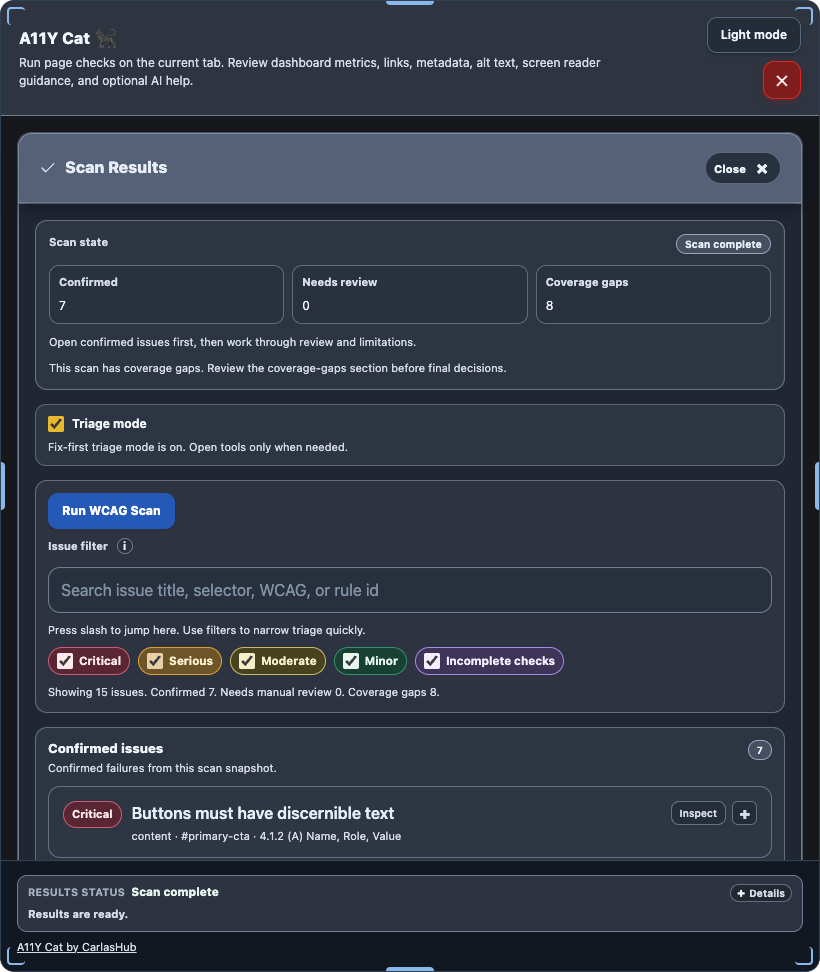
After reading the whole repo history, I would describe A11Y Cat now as an extension-first, local-first accessibility review tool with a fallback bookmarklet path, a fairly serious runtime, a broad review surface, and a stronger evidence culture than a lot of projects at this stage.
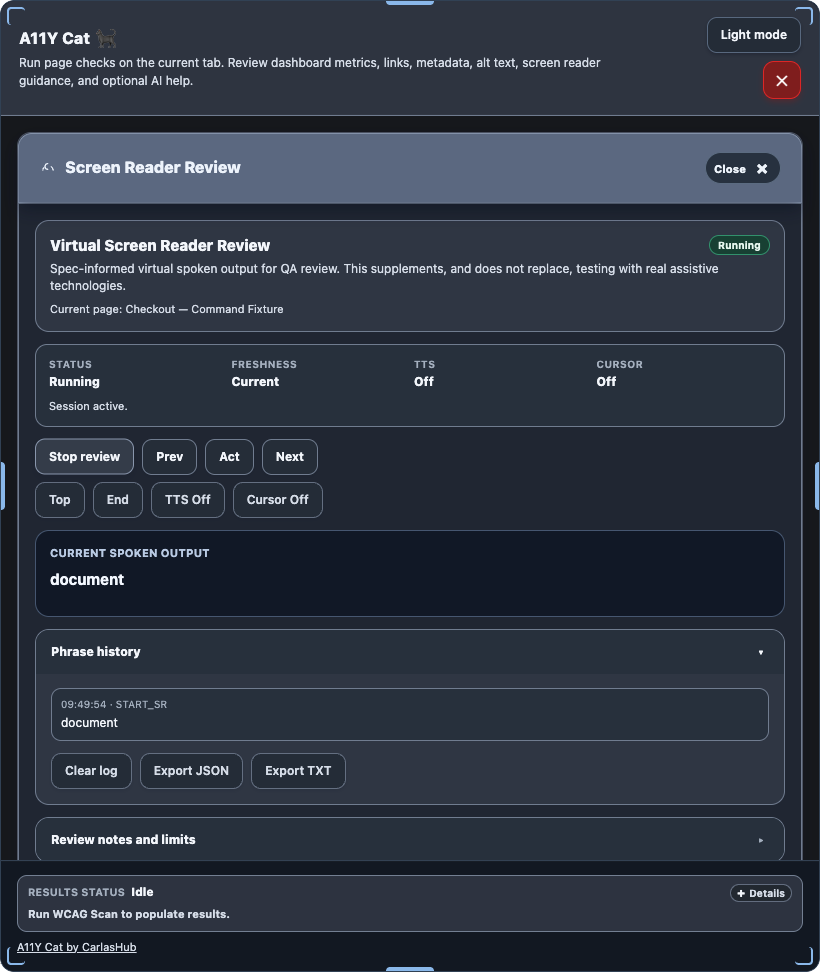
It is not a simple scanner anymore. It has issue taxonomy, trust classes, source attribution, export provenance, diagnostics, coverage reporting, baseline comparison, local issue state, on-device AI hooks, virtual screen reader review support, packaging artifacts, and a release gate that actually has some teeth.
But the repo is also very clear about what it still does not prove.
The current README calls it an advanced prototype, not enterprise-ready. SUPPORTED_ENVIRONMENTS.md says the strongest evidence is desktop Chromium extension mode, with limitations. EXTENSION_RELEASE_CHECKLIST.md still blocks broad public rollout on manual AT sign-off, hostile live-site evidence, and manual toolbar verification. docs/ENTERPRISE_READINESS_GAP.md still calls out runtime concentration risk, dynamic interaction coverage gaps, and broader proof needs.
I think that is the most convincing thing about the current state. The project has become more capable and more disciplined at the same time, but it has not turned that into inflated certainty.
Even the late safety work reflects that. Sandbox analysis gets made inert by design instead of reinserting raw HTML into the live page. The diagnostics bridge gets narrowed so it listens instead of patching page-owned globals by default. High-risk renderers get moved away from dynamic innerHTML patterns, and tests enforce that. Those are not flashy “look what the product can do” features. They are signs that the builder has started treating the tool’s own behavior as something that also needs accessibility, safety, and trust discipline.
So if I were ending the story honestly, I would not say A11Y Cat reached some perfect final form. I would say it became a much more rigorous version of itself.
It started as a practical bookmarklet for quick in-page checks.
It became a much wider browser review tool.
Then it became an extension-first product with stronger delivery, more explicit boundaries, and better verification.
Then it started building governance and safety rules around itself so the repo could defend its own claims.
That is a pretty solid arc for a few intense months of visible history.
Visual evidence
Representative current-state visuals from the repo’s later extension phase:
What I was really learning here
I was learning that capability is only half the story. The other half is whether the tool, the docs, the exports, the tests, and the release process all tell the same truth about what the product can really support right now.
Evidence
- Commits:
e6fb9ab– release-readiness decisions and enterprise evidence docs hardened5ab9f2c– AT sign-off matrix and UI accessibility semantics hardened6061ec2– high-risk renderers hardened away from unsafe dynamic HTMLa990ee6– prompt 7 review approved
- Files:
../../README.md../../SUPPORTED_ENVIRONMENTS.md../../EXTENSION_RELEASE_CHECKLIST.md../../docs/ENTERPRISE_READINESS_GAP.md../../docs/RELEASE_READINESS_CHECKLIST.md../../docs/rendering-safety-policy.md../../docs/sandbox-analysis-safety.md../../docs/page-diagnostics-capture.md