
This is the latest phase in the repo, and it is unusual enough that I think it deserves its own post.
By April 16 and 17, A11Y Cat is not only tightening code. It is tightening how work is scoped, reviewed, recorded, and pushed.
That shows up in several layers at once.
There is AGENTS.md, which sets a very strict implementation and review standard. There are prompt-governance files in docs/prompts/: a current prompt contract, a current review record, a master prompt history, and a process document. There is a repo-discipline script that checks those files, verifies that the target commit exists, verifies that prompt and review files agree, and blocks invalid governance states. There is even an automated review workflow that renders a review assessment into reviews/latest-review.md.
This is a lot of process for a repo that started life as a bookmarklet package.
I do not think that means the project became bureaucratic for the sake of it. I think it reflects how much surface area the repo had accumulated by then. There were multiple delivery channels, multiple docs acting as source of truth, manual review boundaries, release artifacts, prompt-driven changes, and high-risk runtime surfaces. At that scale, “I know what I meant” stops being good enough.
The interesting part is that the governance layer is not generic. It is tied very closely to the repo’s real pain points. Prompt scope must be explicit. The exact target commit under review must be explicit. Review records must reflect what was actually reviewed. Generated-core freshness must be enforced. Source-of-truth paths must exist. Completed work must be pushed. That all feels like policy growing directly out of lived friction.
There is something slightly intense about this phase, and I mean that as a compliment. The repo is no longer satisfied with “the code looks good.” It wants the surrounding workflow to be auditable too.
That probably would have looked excessive at the bookmarklet-only stage. By this point it feels more understandable. The project has become complex enough that the quality bar is no longer just about implementation. It is also about whether the repo can truthfully describe what changed, what was reviewed, and what evidence supports the current state.
Visual evidence
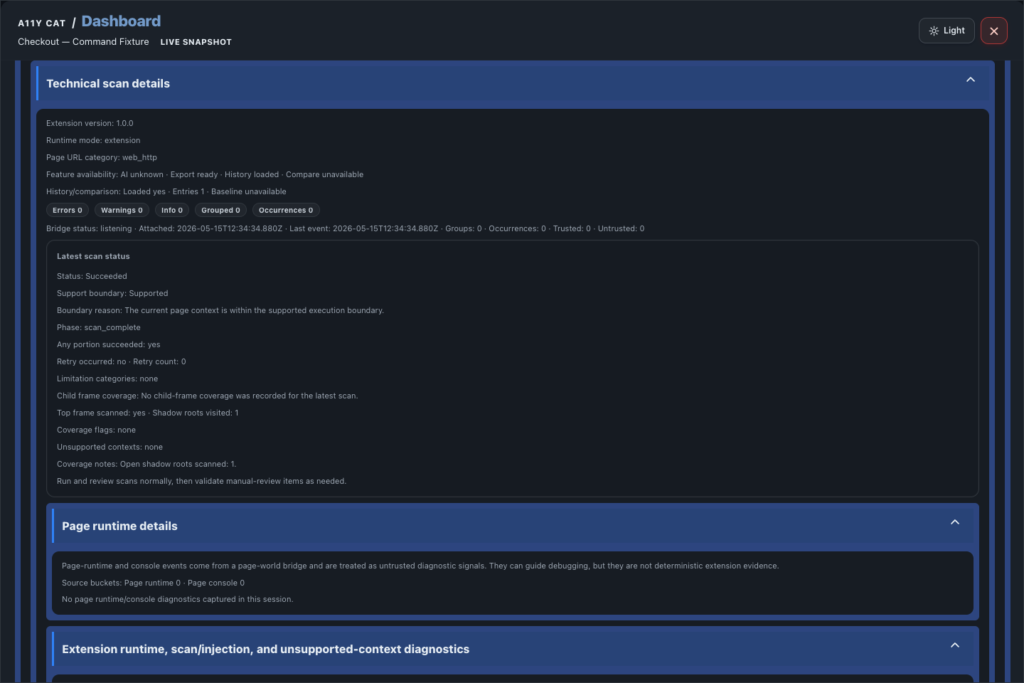
This phase is governance-heavy rather than UI-heavy: prompt contracts, review records, and repo-discipline enforcement. There is no reliable screenshot that would honestly capture that shift, so I am leaving this phase without a visual.
What I was really learning here
I was learning that once a project gets complicated enough, process sloppiness becomes a product risk. If I cared about truthful outputs, I also had to care about truthful review records and scope records.
Evidence
- Commits:
641eba1– commit-aware prompt governance docs addedadbe312– prompt workflow process added6981850– prompt-governance target integrity enforceda990ee6– prompt 7 rendering-safety contract approved
- Files:
../../AGENTS.md../../docs/prompts/current-prompt.md../../docs/prompts/current-review.md../../docs/prompts/master-prompts.md../../docs/prompts/PROCESS.md../../scripts/check-repo-discipline.js../../.github/workflows/review.yml../../reviews/latest-review.md