
This is the kind of work I probably would have avoided earlier, mostly because it sounds unexciting. By this point it had become necessary.
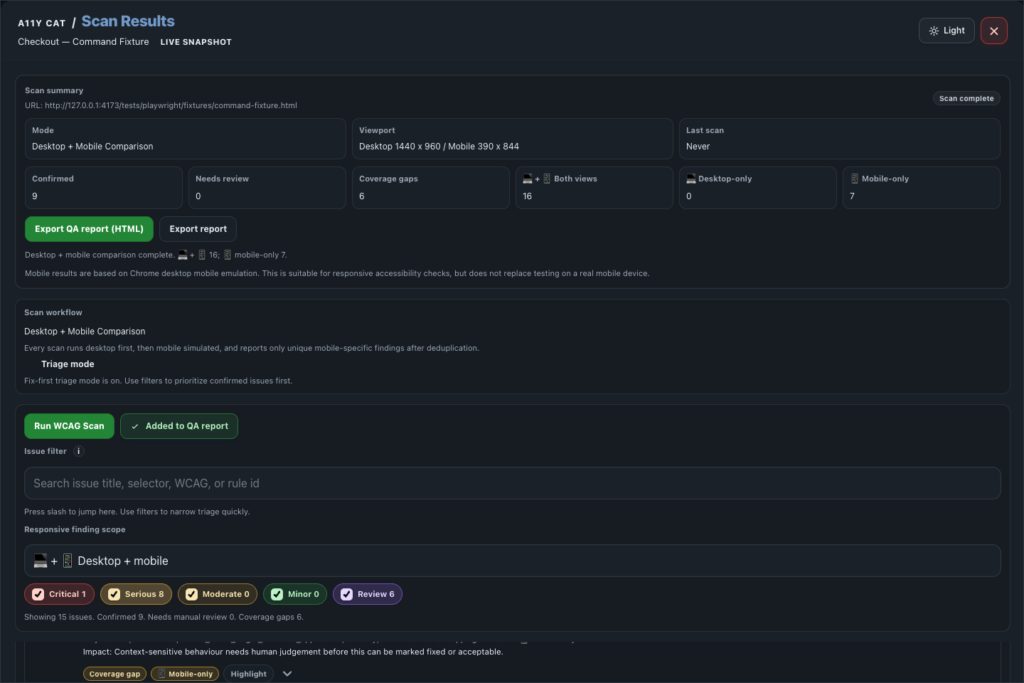
Once A11Y Cat had a public site, a bookmarklet build, a release extension package, a test extension package, reviewer docs, store-review material, screenshots, and a growing verification story, the release process stopped being something I could keep straight in my head.
That is where the packaging and handoff tooling comes in.
By mid-April the repo has canonical artifact packaging for source handoff, QA handoff, release candidate, and browser-store submission. The scripts create deterministic zips, embed metadata, generate an aggregate manifest, and verify that packaged artifacts still match HEAD. There is also still a legacy extension package path for compatibility, but even that gets sidecar metadata for commit and SHA traceability.
I think this is one of the clearest signs that the project had crossed from “small tool” into “serious enough to need release hygiene.” Not enterprise-ready, obviously. The repo itself rejects that claim. But definitely past the point where manual zip-and-hope felt acceptable.
The docs around this are very practical too. docs/ARTIFACT_PACKAGING.md explains which artifact exists for what audience. The extension readme and release checklist tie packaging back to the store-review flow. docs/store-listing.md and docs/chrome-web-store-review.md sit beside the code instead of floating somewhere outside the release process.
There is also a nice discipline loop here with generated-core freshness and clean-tree requirements. The packaging scripts are not just bundling files. They are enforcing assumptions about what counts as a valid release input.
That matters because this project has a lot of generated and build outputs: dist/, dist-extension/, dist-extension-test/, zips, reports, scorecards. If the repo did not get stricter about which of those are source, which are outputs, and which can be packaged for which audience, it would get messy very quickly.
I think this is the kind of engineering work that makes later shipping calmer even if it never looks exciting in a feature summary. It also says something about the builder’s mindset by this point. I was no longer just thinking about code changes. I was thinking about how somebody else would review, test, hand off, and verify the same release candidate without relying on my memory.
Visual evidence
This phase is mostly scripts, zip packaging, metadata, and release handoff docs. There is no reliable screenshot that would honestly represent the main work, so I am leaving it as a non-visual phase.
What I was really learning here
I was learning that once release work starts involving multiple audiences and multiple package types, “just remember the steps” stops working. Tooling around the product becomes part of the product’s reliability.
Evidence
- Commits:
6630805– Chrome Web Store release package prepareddff2606– deterministic canonical packaging artifacts and docs
- Files:
../../scripts/package-extension.js../../scripts/package-artifacts.js../../scripts/artifact-packaging.js../../docs/ARTIFACT_PACKAGING.md../../docs/store-listing.md../../docs/chrome-web-store-review.md../../EXTENSION_RELEASE_CHECKLIST.md